

With hundreds of antennas on the market, it can be overwhelming trying to determine which one is best for your vehicle.
But fear not! In this article, we'll recommend what we consider to be the best CB antennas on the market today as well as explain the fundamental principles you need to understand to pick the right antenna.
Here at Right Channel Radios, we specialize in CBs for trucks, 4x4s, Jeeps, off-road vehicles and commercial/construction equipment. So while we'll discuss all types of antennas, we'll be offering advice specifically with truck and 4x4 drivers in mind below.
Own a Pickup or Jeep? You may want to jump directly to our vehicle specific antenna guides here for Jeeps and Pickup Trucks.
Fiberglass Antennas
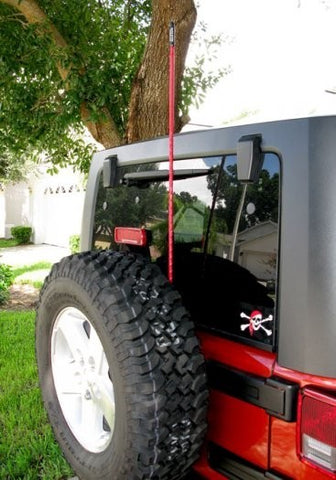

Fiberglass antennas range in length from 2' to 7'. They're built from a fiberglass rod, with the antenna wire wound along the outside underneath a plastic wrap. The antenna coil for fiberglass antennas is usually located at the top of the antenna. For more details, see our full guide on fiberglass CB antennas.
Approximate Range: 2 to 7 Miles
Transmit and receive range will vary dramatically based on conditions and the mounting location of the antenna. But for a rough approximation, you can expect the following range from these lengths of fiberglass antennas.
- 2' Length: 2 to 3 miles
- 3' Length: 3 to 4 miles
- 4' Length: 4 to 6 miles
- 5' Length: 5 to 7 miles
Pros - Durable & They Mount Anywhere
Fiberglass antennas are usually the best choice for 4x4 and off-road drivers. They're the most durable type of antenna and hold up best to the rigors and abuse of off-road use.
Because they can utilize any one of hundreds of different mounts, they can be mounted just about anywhere on your vehicle - often being paired with vehicle specific mounts for factory-looking installs.
Even if the mounting location you choose is in the middle of the vehicle, you can usually pick a long enough antenna to get the coil (the most important part) above the roofline to ensure acceptable performance.
Cons - Range is Not Top-Notch
For truck and off-road applications, there aren't too many cons for fiberglass antennas.
They're not quite as powerful as a similar length magnetic or center-load antenna. And you do need to buy the mount and coax separately unlike a magnet antenna that is an all-in-one package. But that's about it.
The Firestik FS - Our Favorite Fiberglass Antenna
The Firestik FS is hands-down our favorite fiberglass CB antenna. It's beefy, works extremely well and is made right here in the USA. You can't go wrong picking it for just about any use - especially for pickup truck and off-road applications. See the Firestik FS here.

Magnet Mount Antennas
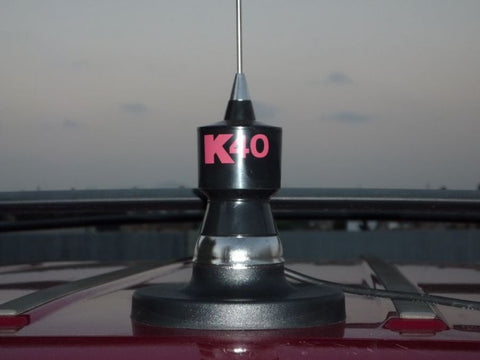

Magnet mount antennas, like you'd probably guess from the name, utilize a magnet base to secure the antenna to the vehicle. They come with everything you'll need in one package as the coax, magnetic mount and whip antenna are all included.
The coil for magnetic CB antennas is in the magnetic/plastic base assembly at the very bottom of the antenna. The central mounting location and height of the antenna (at the highest point on the vehicle) will result in the best performance you'll be able to get in any single antenna install apart from a 102" whip. For more information, explore our magnet mount CB antennas.
Approximate Range: 3 to 7 Miles
Transmit and receive range will vary dramatically based on conditions and the mounting location of the antenna. For a rough approximation, you can expect the following range from these lengths of magnetic antennas.
- 3' Magnet Antennas: 3 to 4 Miles
- 5' Magnet Antennas: 5 to 7 Miles
Pros - Great Performance & Easy Installation
If you have a vehicle with a metal roof, it's hard to beat the performance of a tall magnet mount antenna on your roof. The central mounting location and height of the antenna (at the highest point on the vehicle) will result in the best performance you'll be able to get in any single antenna install apart from a 102" whip.
In addition, it is super easy to install. Unlike other antennas that require special mounts that often require drilling into your vehicle, a magnetic mount antenna installs simply and cleanly to your rooftop. Just set it in place and you're done!
Cons - Clearance and Durability
While you'll enjoy impressive performance, you're more likely to have clearance issues with a magnetic mount antenna given its high mount location.
Magnetic mount antennas utilize an antenna whip that inserts into the magnetic/plastic base. Unlike a fiberglass antenna, these whips are very thin, similar in diameter to a paperclip.
If you hit the top portion of the whip on an antenna or tree limb, it will likely bend out of the way. But if you catch the whip lower down, you're very likely to severely bend or even break it. So, magnet mount antennas aren't a great choice if you know your antenna will be taking a good deal of abuse.
The Wilson Little Wil - Our Favorite 3' Magnet Antenna
The Wilson Little Wil antenna is extremely affordable and offers a great blend of performance without limiting your clearance by too much. It's by far our best selling compact magnet antenna. See the Wilson Little Wil here.

The Wilson 1000 - Our Favorite 5' Magnet Antenna
At 62 inches, the Wilson 1000 is a much larger antenna and it performs extremely well. Installed on your rooftop, you'll likely get between 5 to 7 miles on average and - given the right conditions - significantly more. The whip portion also screws off at the base, so you can remove the whip to improve clearance while still leaving the magnetic base and coax attached. See the Wilson 1000 here.

102" Whip Antennas

Given the title of this article, "Choosing the Best CB Antenna", perhaps we should have put this one at the top. The 102" whip antenna will, without a doubt, provide you with the best performance of ANY of the antennas on this page!
Unlike the other antennas mentioned, there is no coil location for this antenna. It doesn't need one because the 102" represents a perfect 1/4 CB wave length. All of the other antennas we mention take 102" of wire and wrap it up tightly to simulate a 102" whip. This antenna is the real deal. Learn more about 102-inch whip CB antennas.
Range - 10 Miles or More
The title about sums it up! You'll usually get at least 10 miles - often significantly more - with a 102" whip antenna.
Pros - Incredible Performance & Affordable
If you haven't gathered yet, the 102" whip will give you top-notch performance. It's incredible! It's also relatively inexpensive given its size, and will cost you significantly less than a center load or even many magnet mount antennas.
Cons - It's Enormous!
102" is 8.5 feet. That's enormous. Even when mounted to your bumper, this antenna will stick well above your roofline.
Given its size and weight, you'll also want to invest in a fairly heavy-duty mount to support it. People will most often use a ball mount or a sturdy 3-way bracket to keep this beast well secured.
From an off-road perspective, it can be a great choice if you'll exclusively be driving in open air, desert-like conditions. But if you'll be venturing into wooded areas, it's probably a poor choice due to its size and clearance issues.
Our Favorite 102" Whip
This classic 102" CB antenna whip has been a winner for us, with customers reporting outstanding performance.
Trucker Antennas (Center-Loaded Antennas)
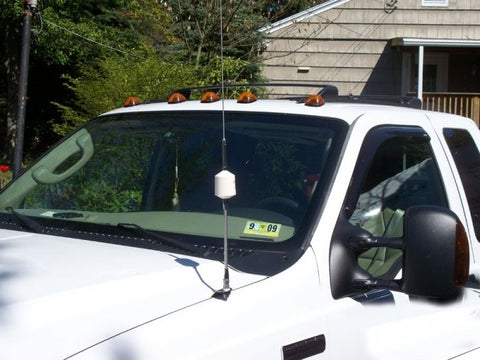

Dubbed "trucker antennas" because they're most often used by semi-trucks, center-loaded antennas are built for long-haul performance. If you're considering this type, you can browse our selection of trucker CB antennas to find the right fit for your rig.
The coil sits above this shaft, usually in a plastic housing, and the remainder of the antenna consists of a long, thin steel whip similar to the kind of whip used in magnet mount antennas.
Trucker antennas have their coil located in the plastic housing, usually located near the bottom portion of the antenna.
Approximate Range: 7 to 10 Miles
Transmit and receive range will vary dramatically based on conditions and the mounting location of the antenna. While trucker antennas will often range slightly in height between 45" and 60", a rough range of 7 to 10 miles is a good approximation of what you'll see from most models.
Pros - Great Performance
Of all the antennas (excluding a 102" whip), center load trucker antennas offer the best performance when compared to similarly mounted antennas of the same height. For drivers who can mount them high enough on their vehicles and will use them exclusively for on-road use (like semi truck drivers), they can be a good option.
Cons - Expensive & More Damage Prone
Trucker antennas are expensive. Compared to a $25 fiberglass antenna, a good center load antenna will cost you $60+, and this is before you purchase a mount and coax.
They're also much more prone to damage if hit. The elevated plastic coil is more susceptible to damage than a low magnetic base. And the lower metal shift, while solid, is unforgiving and has the potential to bend the mount and your vehicle if impacted strongly enough.
The Wilson 2000 - Our Favorite Trucker Antenna
A perennial performer, the Wilson 2000 offers great performance at a reasonable price for a trucker antenna. Some may tell you to step up to the Wilson 5000, but the only reason to do that would be if you're running a souped up, high wattage radio. If you're not, save your money and stick with the Wilson 2000. See the Wilson 2000 here.

No-Ground Plane (NGP) Antennas


When installing a CB antenna on an RV, boat or any vehicle with no metal chassis, a no-ground plane CB antenna kit is required. For recommendations, check out our no-ground plane CB antennas.
Pros - They Work Without Metal
The best part of a no-ground setup? It will actually work! If you try to install a standard CB setup on a vehicle with a lot of fiberglass, or without a sufficient ground, it simply won't function properly. You'll get frustrated and probably do something you'll regret. So, if in doubt, stick with no-ground plane equipment.
Cons - More Expensive, Reduced Range
No-ground equipment is slightly more expensive than standard CB equipment. But the biggest difference is range. Compared to a standard CB setup, you'll likely only get 70% to 80% of the range you'd see from a typical antenna.
Our Favorite No-Ground Antenna
The Firestik No-Ground 3-Way CB Antenna Kit is our favorite NGP kit. It contains super high-quality components and a versatile 3-way mount so you can install it on just about anything. If you're looking for a side-mount option, they also make a great no-ground side mount kit that's similar.
Should I Install Dual Antennas?


Dual antennas are especially popular on pickup trucks, and can be a great way to improve your range - especially if you often pull a large trailer or other load that can obstruct the signal of a single antenna.
However, they're not usually a great choice for off-road use and there are some important things to consider before installing them. Because dual antennas are a bit of nuanced beast, we've written a dedicated article about the topic. Check out our Dual CB Antenna Guide here.
Mounting Location Considerations
Antennas can be mounted in a variety of places, including on a vehicle’s roof, mirror bars, hood channel, bumper and trunk. Each method has advantages and disadvantages, so it is up to the individual to weigh these options relative to his or her own needs and preferences. Here are a few general rules to keep in mind when considering CB mounting locations:
- Antennas mounted higher on the vehicle tend to perform better.
- The antenna's coil should be above the roofline of the vehicle (coil location is discussed in the next section).
- For optimal performance, at least half of the antenna should be above the roofline.
It’s critical that the antenna mount be well-grounded to the vehicle chassis. If a grounding jumper is used to ground the mount, it should be as short as possible. If installing an antenna on an RV or a vehicle without a sufficient ground, please refer to the “No-Ground Plane Antennas” section of this article.
Single antennas (vs. dual co-phased antennas) perform best when mounted near the center of the vehicle. When mounted to one side or another - especially if not mounted high enough - dead spots can occur where the vehicle blocks the antenna from effectively transmitting or receiving.
Finally, longer antennas work better than shorter ones, so select the longest length that can be comfortably used. Quick disconnects and other accessories allow for fast and tool-free CB antenna removal when additional clearance is required (garage parking, drive-throughs, etc).
Though it’s not always possible to adhere to all our CB antenna mount suggestions, following as many as possible will result in better antenna performance.
Understanding Antenna Coils

An antenna’s coil position refers to the location where the antenna wire is wound into a coil. What is a coil and why is it needed?
The optimal antenna length for CB frequencies is 102” as this represents one-quarter of a wavelength. Unfortunately, mounting a 102” (8.5-foot) antenna to a vehicle is often not a viable option.
To get around this problem, manufacturers wrap coil tightly along the antenna body in order to compensate for the reduced antenna length. In other words, a longer length similar to that of the 102” whip is achieved on a shorter CB antenna by wrapping the antenna wire close together, forming a coil. This tightly wrapped "coil" portion of the antenna is usually concentrated in a specific area - at the bottom, middle or top.
Though this isn’t nearly as efficient as using a regular 102” antenna, it allows for shorter and more practical CB antennas.
The coil on a CB antenna is the area where it most strongly receives and transmits a signal. In terms of mounting, it's important to make sure the antenna's coil clears the roofline. Otherwise, the most active part of the antenna will be blocked/hidden by the roof and performance will suffer.
Picking the Right Antenna Mount
If you're planning to use a non-magnetic mount antenna, you'll need to pick a mount to secure it to your vehicle. Picking a mount is beyond the scope of this article, but you can get recommendations based on your specific vehicle from our vehicle mount selection wizard.
Alternatively, we've written guides specifically on pickup truck mounting options and Jeep mounting options, as well as a comprehensive video guide for all vehicles picking the right CB mount. And if you're simply interested in shopping our entire selection, you can browse all our CB antenna mounts here.
Who Are We?
We specialize in rugged CB installs for trucks, Jeeps, 4x4s, construction equipment and other beefy vehicles. We're the nation's #1 source for heavy-duty CB needs, a reputation we earned the hard way: by giving more than 100,000+ past customers the outstanding service they deserved.
Next Steps for Getting an Antenna
Hopefully this has given you a great foundation! From here, use the links below to put your newfound knowledge to use and find the best antenna for your vehicle.
- Learn More About Antennas for Jeeps or Pickup Trucks
- Fiberglass Antennas
- Firestik FS CB Antenna (Our Favorite)
- Shop All Fiberglass Antennas
- Magnetic Antennas
- Wilson Little Wil (Favorite 3')
- Wilson 1000 (Favorite 5')
- Shop All Magnet Mount Antennas
- Trucker Antennas
- Wilson 2000 (Favorite Trucker Model)
- Shop All Trucker Antennas
Next up: CHOOSING THE BEST CB RADIO